

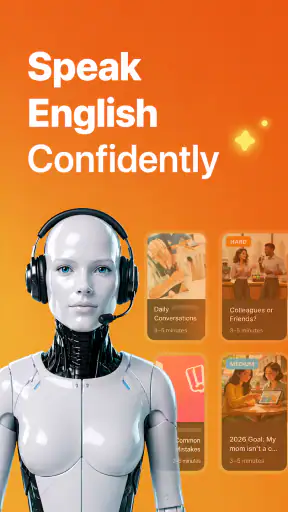
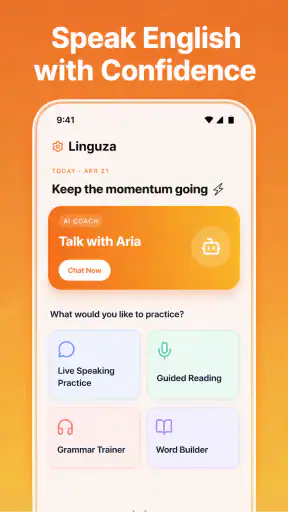
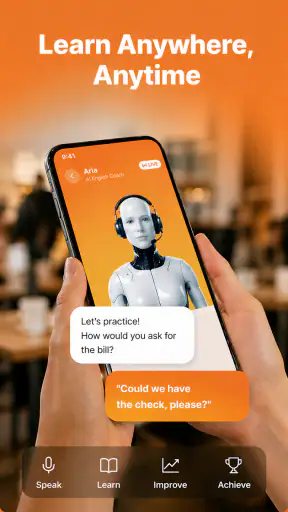
I approached Linguza: AI English Tutor as a practical decision rather than another language app to collect and forget. Its promise is straightforward: use an AI tutor to speak and practise English whenever you have a moment. That makes it most interesting for people who want regular conversation practice but do not always have a teacher, class, or patient speaking partner available.
My experience is that the app makes the most sense when your main obstacle is using English out loud. It belongs to the education category, comes from NXL AI Solutions, and is free to install, although some in-app items cost between $6.99 and $89.99. That combination means you can try the learning style without paying immediately, but you should still decide what kind of practice you actually need before committing to anything.
The public response is mixed but substantial: Linguza has an average rating of 3.7 from around 2.9 thousand ratings, alongside more than 5 million installs. I read that as a useful signal rather than a verdict. Plenty of learners find the idea valuable, while the less-than-perfect score suggests that an AI conversation partner will not suit every learning style or expectation.
How I Would Decide Whether Linguza Fits
Start with the skill you are trying to improve
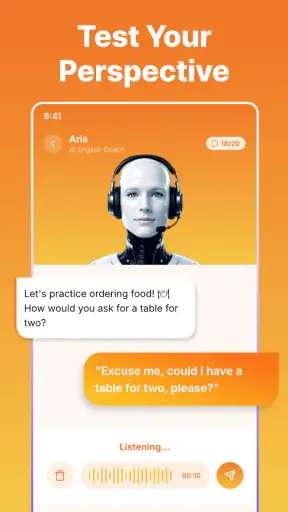
The first question is not whether Linguza is popular; it is whether speaking is the part of English that keeps holding you back. If you already understand grammar exercises and can read comfortably but freeze during a conversation, an AI tutor can offer a lower-pressure place to rehearse. You can try a sentence, notice where you hesitate, and repeat the situation without worrying about embarrassing yourself in front of another person.
That is different from choosing an app mainly for vocabulary memorisation. Flashcard tools are often better when you need to retain a large set of words, while structured course apps can be stronger when you want a clear sequence from beginner lessons to more advanced material. Linguza is more appealing when the missing habit is active use: forming a reply, asking a question, or keeping a short exchange going.
I would also separate speaking confidence from pronunciation perfection. An AI tutor may help you become more willing to speak, but that does not automatically make it a complete pronunciation coach. If your goal is a formal accent assessment, specialist feedback from a teacher or a dedicated pronunciation service may be more appropriate. Linguza can be part of that routine, not necessarily the entire solution.
Consider when and where you will practise
The app’s strongest practical argument is flexibility. A learner who has ten spare minutes before work, during a commute, or after dinner can open it and practise instead of waiting for a scheduled class. This matters because consistency is often more important than occasional long study sessions. A short exchange repeated regularly can be easier to maintain than a demanding weekly plan.
At the same time, “anytime” does not mean every situation is suitable. Speaking practice needs enough privacy and attention to be useful. If you are in a noisy public place, rushing between tasks, or unable to speak aloud, the experience may become awkward or less productive. I would treat those moments as review time rather than forcing a conversation when you cannot concentrate.
A realistic routine would be to use Linguza after learning a small group of phrases elsewhere. Instead of merely recognising them on a screen, I would try to use them in a short exchange about a familiar subject. The important step is not finishing a long session; it is turning passive knowledge into a response you can produce without translating every word in your head.
Think about your tolerance for AI-led learning
Some learners enjoy practising with an AI because it removes social pressure. Others find the interaction less motivating than a real person. I fall somewhere in the middle. For repetition, experimentation, and quick practice, an AI tutor is convenient. For natural interruptions, cultural nuance, and the unpredictable rhythm of a real conversation, a human partner remains difficult to replace.
This distinction should guide your expectations. Linguza can help you build a bridge toward conversation, especially if you are shy or out of practice. It is less convincing as a substitute for every form of English exposure. I would still combine it with listening to real speakers, reading material at your level, and occasionally speaking with people who can respond in genuinely varied ways.
What the free entry point really means
Because the app is free, trying it is relatively simple. The important decision comes later, when you encounter optional purchases. The available in-app items range from $6.99 to $89.99 per item, so I would not start by assuming that paying will solve every learning problem. First, use the free experience long enough to judge whether you actually return to it and whether the conversations target the difficulty you have.
My practical rule is to pay only when the app has already become part of your routine. If you open it once, enjoy the novelty, and stop using it, a larger purchase is unlikely to change the outcome. If you are practising consistently and the paid material removes a specific limitation that matters to you, the decision becomes more reasonable. The value depends on repeated use, not on the size of the feature list.
Where Linguza feels most useful
The clearest advantage is the reduced friction between deciding to practise and actually speaking. There is no need to coordinate schedules with a tutor or wait for a language exchange partner to be available. That makes it especially useful for learners who understand English but lack opportunities to produce it.
I also like the privacy of an AI practice space for mistakes. Many people know the answer in their head but avoid saying it because they fear sounding slow or incorrect. A private rehearsal can make that first attempt easier. Once a phrase feels familiar in the app, it may be less intimidating to use it with another person.
Another strength is its usefulness for small, specific moments. Before a trip, an interview, a presentation, or a customer-facing shift, I would use it to rehearse likely exchanges. I would not expect that preparation to cover every surprise, but it can make common openings and replies feel less foreign. That is a more realistic benefit than expecting the app to transform your overall level after a few sessions.
A workflow that gives the app a fair test
To evaluate Linguza properly, I would avoid random conversations at first. I would choose one situation, such as introducing myself, asking for clarification, or explaining a simple problem. Then I would practise the same situation several times while changing one detail in each attempt. This tests whether I can transfer a phrase instead of memorising a single script.
After each session, I would write down two things: one sentence I could say comfortably and one point where I became stuck. The first shows progress that is easy to overlook; the second tells me what to practise next. This simple record also prevents the common mistake of judging a language app only by how entertaining the session felt.
A less obvious tip is to use the app for recovery practice. When a conversation goes badly in real life, recreate the situation soon afterward and try a simpler response. The goal is not to reproduce the exact exchange but to build a fallback sentence for next time. That turns an embarrassing moment into a practical lesson and uses the AI format for something a static course cannot easily provide.
Where the experience may create friction
AI conversation can feel convenient, but convenience can also hide weaknesses. An app may allow you to keep responding without forcing you to notice why a sentence sounds unnatural. If I were using Linguza, I would actively pause after difficult exchanges instead of treating every completed reply as proof that the practice was effective.
There is also a motivational trade-off. A human teacher can notice that you are repeating the same mistake, adjust the lesson, and hold you accountable. An app is easier to access, but that ease makes it equally easy to skip. Learners who need external structure may get more from scheduled classes, even if those classes are less flexible.
The average rating of 3.7 is worth keeping in mind here. It does not make the app a poor choice, but it does suggest that the experience is not universally satisfying. I would be cautious if you expect a polished replacement for a personal tutor, a complete curriculum, or perfectly natural conversation in every situation. The app is better judged as an accessible practice tool than as a total language-learning system.
When another category is the better choice
If you are starting from almost no English, I would first look for a course with explicit explanations, carefully sequenced lessons, and visible progression. Speaking practice is valuable at that level, but without basic vocabulary and sentence patterns, an open conversation can feel confusing rather than encouraging.
If your priority is exam preparation, choose resources built around the exam format. Linguza may help you practise speaking under pressure, but exam success also depends on the specific task types, scoring criteria, reading demands, and writing conventions of the test you are taking. A general AI tutor should not be your only preparation method.
If you need professional correction, a human teacher may offer better value despite the higher effort and scheduling demands. A teacher can explain why a phrase is inappropriate in a particular context, distinguish a minor error from a serious one, and adapt immediately when you do not understand. That depth is especially important for advanced learners who are no longer struggling with basic confidence but with precision.
Language exchange communities can be a better fit for learners who mainly want cultural conversation and real interpersonal connection. They bring their own uncertainties, including unreliable partners and uneven language levels, but they expose you to reactions an AI may not reproduce. I would choose Linguza for convenient rehearsal and a human exchange for broader conversational reality.
What switching to Linguza involves
Moving from a traditional learning app to Linguza is not just changing interfaces. You are changing the unit of practice from completing a lesson or reviewing a card to producing language. That can feel uncomfortable at first because speaking reveals gaps immediately. I would make the transition easier by keeping one familiar study activity, such as reading or vocabulary review, and adding short AI conversations rather than replacing everything in one day.
The reverse is also true. If you move away from Linguza to classes or language exchange, you may lose the ability to practise on demand. The replacement needs to solve that access problem, or your speaking practice may happen less often. Before switching, I would ask whether the issue is the app itself or simply an inconsistent routine. A different tool cannot compensate for a schedule that leaves no room for practice.
There is little reason to treat the choice as permanent. The app is free to begin with, and its most useful role may be alongside other resources. For example, a learner could study grammar through a structured course, use Linguza to turn that grammar into spoken replies, and then test the same skills with a person. That division of labour is more realistic than demanding one app handle every part of language learning.
Compatibility and practical expectations
Linguza is available for Android devices running version 7.0 or later, which covers a broad range of phones. It is rated for Everyone, so its presentation is suitable for a general audience, although parents should still decide whether AI-based language practice fits a child’s learning needs and supervision arrangements.
The current version is 1.6.0, and the developer is NXL AI Solutions. I mention those details because they are useful when checking whether your device can run the app and when comparing the installed version with what appears in the app store. They also reinforce a sensible habit: keep the app updated and reassess the experience after major changes rather than relying entirely on an old first impression.
I would not choose it solely because it has passed the five-million-install mark. Popularity can show that the concept reaches many people, but it does not tell me whether the learning style matches my goals. The more useful test is personal: can I practise regularly, do I speak more freely after using it, and do I know what to work on next?
My recommendation for different learners
I recommend Linguza to busy learners who already have some English and want more chances to speak. It is particularly suitable if you avoid conversation because you feel self-conscious, if your schedule changes constantly, or if you need a quick way to rehearse everyday situations. The free starting point makes it reasonable to test without treating the app as a major commitment.
I would recommend it less strongly to complete beginners who need a carefully guided foundation, advanced students seeking detailed correction, and exam candidates looking for syllabus-specific training. Those users may still find a supporting role for it, but another category of resource should probably lead their study plan.
My best advice is to judge it after a deliberate trial rather than after one entertaining exchange. Set a small speaking goal, practise it repeatedly, and notice whether your responses become easier to produce. If the app helps you speak more often, it is doing something valuable even if it does not replace a teacher. If you need structure, accountability, or nuanced human feedback and never develop a regular habit with it, switching to a course or tutor will likely be the better decision.
Overall, Linguza is a useful bridge between studying English privately and using it in the real world. I like its low barrier to practice and its potential to make mistakes feel less intimidating. I would keep its limits in view, especially the difference between AI rehearsal and genuine human conversation, and I would delay paid purchases until the routine proves itself. For the right learner, the real benefit is not passive exposure but the extra opportunities to form spoken English.


